


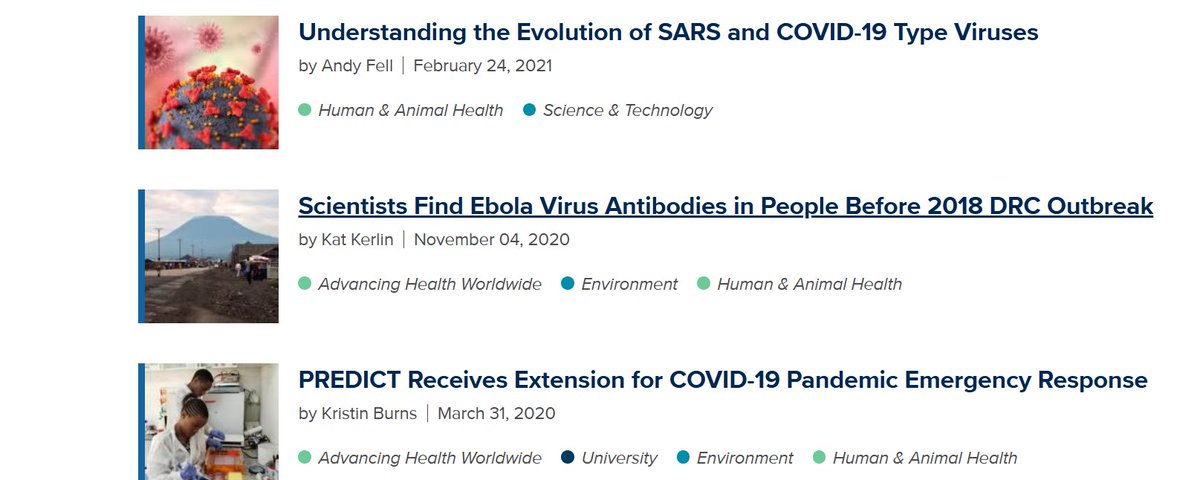
USAID PREDICT, UC Davis One Health Institute, Metabiota, EcoHealth Alliance, Gorilla Doctors, and the One Health Workforce–Next Generation (OHW-NG) project...
...have driven extensive field surveillance, laboratory strengthening, workforce training, and multi-sectoral response efforts for Ebola virus disease (EVD) in the Democratic Republic of the Congo (DRC).
These initiatives operate through the USAID Emerging Pandemic Threats (EPT) framework, emphasizing wildlife-human interfaces in the Congo Basin—one of the world’s highest-risk zones for filovirus spillover. Activities center on proactive pathogen detection in bats, rodents, and primates; rapid diagnostics; community risk assessment; and integrated One Health training that links veterinary, public health, and environmental sectors to interrupt transmission chains before or during outbreaks.
PREDICT - The program that gave us Covid
The PREDICT project, led by UC Davis One Health Institute with core partners EcoHealth Alliance, Metabiota, Wildlife Conservation Society, and Smithsonian Institution, maintained a sustained presence in the DRC from 2009 through 2019.
Metabiota served as the primary implementing partner for DRC operations, managing in-country teams responsible for viral sampling, laboratory diagnostics, and data systems. PREDICT teams collaborated directly with the DRC’s Institut National de Recherche Biomédicale (INRB) and Ministry of Health, embedding expertise into national public-health infrastructure.
Fieldwork under PREDICT targeted high-risk interfaces in the Congo Basin, including bat roosts, bushmeat markets, and primate habitats. Teams collected thousands of biological samples from wildlife reservoirs known to harbor Ebola-related filoviruses, building a regional database of viral diversity and spillover potential.
Laboratory capacity expanded through PREDICT-funded upgrades at INRB facilities in Kinshasa and field sites, enabling faster on-site PCR testing and serosurveillance. Metabiota coordinated logistics, supply chains, and quality assurance, while EcoHealth Alliance contributed to ecological modeling of human-wildlife contact patterns.
Gorilla Doctors
Gorilla Doctors, a UC Davis-affiliated PREDICT partner, extended this work to great-ape conservation zones. On February 28, 2019, in Goma, North Kivu Province—amid the largest DRC Ebola outbreak to date—Gorilla Doctors convened a full-day One Health workshop titled “Awake Awareness.” The session trained 8 veterinarians, 3 public health experts, and 60 laboratory technicians from government Ebola response teams.
Presentations covered the One Health approach, Ebolavirus history and evolution, laboratory biosecurity best practices, PPE protocols, and diagnostic techniques. Dr. Eddy Kambale Syaluha, PREDICT eastern DRC Country Coordinator and Gorilla Doctors head veterinarian, led the overview module; other instructors included Gorilla Doctors field veterinarians and INRB lab personnel. The workshop addressed the outbreak’s proximity to Virunga National Park, where human-to-gorilla transmission posed existential risk to endangered mountain and Grauer’s gorillas.
By equipping participants with cross-sectoral tools, the program reinforced surveillance along park boundaries, promoted safe carcass sampling, and integrated wildlife health monitoring into human outbreak response—directly linking PREDICT’s surveillance mandate to primate conservation. Gorilla Doctors committed to repeating the training with local universities and producing French-language community materials for broader dissemination.
OneHealth (EcoHealth Alliance)
Parallel to PREDICT, the One Health Workforce–Next Generation (OHW-NG) project—another UC Davis-led USAID EPT-2 initiative—built sustainable training pipelines through the Africa One Health University Network (AFROHUN) in the DRC. Partner universities, including the University of Kinshasa School of Public Health (UNIKIN-KSPH) and University of Lubumbashi School of Veterinary Medicine (UNILU), integrated One Health competencies into curricula.
Between December 2020 and March 2021, a five-day Training-of-Trainers workshop engaged 40 KSPH faculty members across departments, embedding modules on risk assessment, gender-sensitive response, multisectoral coordination, and filovirus preparedness.
These competencies directly bolster DRC’s capacity to manage recurrent Ebola events in provinces such as Equateur, North Kivu, and Ituri. AFROHUN DRC also trained territorial administrators from Kongo Central and Kwango provinces in infectious disease management, including outbreak investigation, contact tracing, and community engagement—skills critical for Ebola hotspots where rural health systems face logistical and security constraints. Student One Health Innovation Clubs (SOHIC) conducted awareness campaigns, such as Rabies Prevention Day events in Kinshasa that extended messaging to broader zoonotic threats including Ebola.
These training programs emphasize experiential learning and policy integration. OHW-NG supported data scans of national One Health workforce needs, alumni tracking, and communities of practice that connect DRC graduates working in Ministry of Health rapid-response teams.
By strengthening sub-national surveillance and response structures, OHW-NG complements PREDICT’s legacy of laboratory and field infrastructure, creating a pipeline of locally trained professionals ready to deploy during filovirus alerts.
University of New Mexico
The University of New Mexico’s Project ECHO platform further amplified response capabilities across African Ebola-affected regions. ECHO’s telementoring model delivered real-time training to frontline health workers on case management, laboratory diagnostics, infection prevention, PPE use, and safe burial protocols.
During outbreaks, ECHO hubs rapidly scaled sessions—training hundreds of clinicians daily—drawing on WHO and regional experts. While specific DRC ECHO cohorts focused on broader hemorrhagic fever preparedness, the network’s infrastructure supported cross-border knowledge sharing with DRC teams facing recurrent events. This virtual mentorship reduced response delays by equipping remote facilities with standardized protocols, directly addressing gaps in rural DRC where Ebola often emerges.
In Conclusion
Collectively, these programs illustrate a layered strategy: PREDICT provided the foundational surveillance and detection backbone; Metabiota and EcoHealth executed field operations; Gorilla Doctors operationalized wildlife-human linkages; OHW-NG/AFROHUN institutionalized workforce development; and Project ECHO sustained real-time clinical capacity.
In a country that has recorded more than a dozen Ebola outbreaks since 1976, these interconnected initiatives have allegedly shortened detection-to-response intervals and reduced community transmission potential through proactive, science-driven preparedness at the animal-human-environment interface.
But, "Are they fixing their own problem?" is the question that remains to be answered, but perhaps the most revealing pattern from all of these initiatives:
The international medical community is capitalizing on racism by wrangling billions of dollars to combat diseases they develop, and blame third-world cultures for spreading the diseases to the general public as their plausible deniability.
Source notes from the original posts
These links came from the companion posts published with the article.
- https://www.ucdavis.edu/news/uc-davis-awarded-100-million-lead-program-predict-and-prevent-pandemic-threats
- https://gorilladoctors.org/gorilla-doctors-lead-one-health-workshop-on-ebolavirus-in-drc/
- https://ohi.vetmed.ucdavis.edu/programs-projects/one-health-workforce-next-generation
- https://projectecho.unm.edu/story/emergency-response-echo-africa-ebola/
- https://usrtk.org/covid-19-origins/metabiota-safety-and-data-problems/
- https://ohi.vetmed.ucdavis.edu/programs-projects/predict-project
- https://www.nejm.org/doi/full/10.1056/NEJMoa1411099
- https://afrohun.org/drc/