


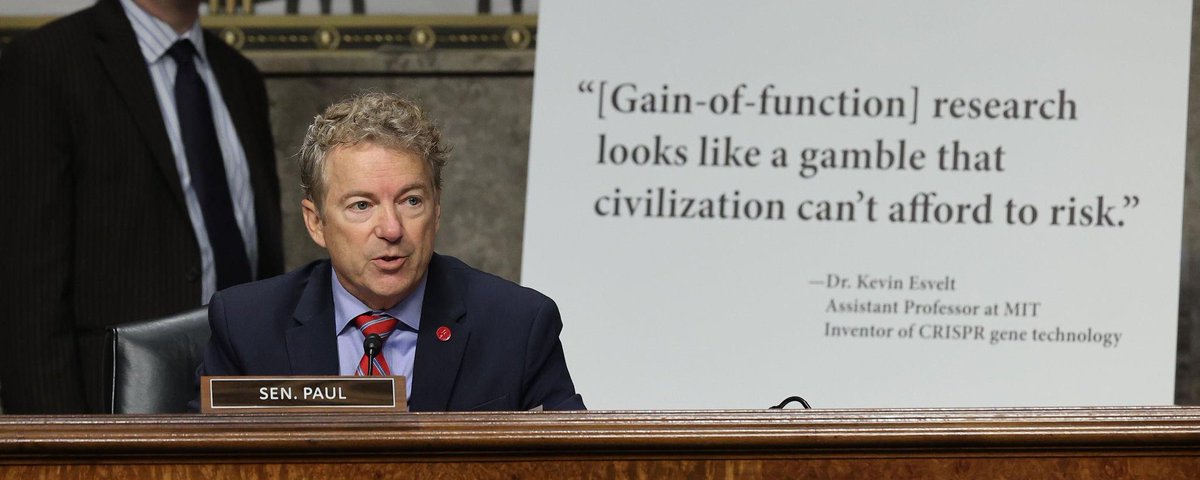
Ahead of tomorrow’s Senate whistleblower hearing, this is public-record research showing why lawmakers should ask whether the same scrutiny now applied to COVID-origin, NIH, EcoHealth, WIV, and gain-of-function oversight should also be applied across adjacent federally funded viral-surveillance and host-range research networks. (1)
The hantavirus threads point to a recurring set of research lanes: clinical treatment, rodent surveillance, human HFRS surveillance, isolate genetics, phylogeny, ecological modeling, host-range biology, receptor biology, immune-response evasion, reverse-genetics tools, diagnostics, animal models, countermeasures, and foreign field-data access.
Nuance
The key caveat matters: public sources do not show a single visible "modern U.S.–China engineered hantavirus GOF program." What they do show is a body of work that overlaps with categories Congress, NIH, HHS OIG, Rand Paul, and the House COVID committee have already treated as oversight-sensitive in the coronavirus context. (2)(3)(4)
The correlation worth drawing is not that COVID and human-to-human hantavirus share a proven origin story, but that both sit inside the same unresolved oversight problem: U.S.-linked scientists, foreign outbreak data, viral sequencing, animal reservoirs, host-range questions, and public agencies that often ask the public to trust internal review processes only after a crisis.
Background
Years before COVID placed Wuhan at the center of a global origins fight, American military and biomedical researchers were already deeply involved in hantavirus work: a U.S.–China ribavirin trial for hemorrhagic fever with renal syndrome studied hundreds of Chinese patients and was published in 1991, showing formal U.S. engagement with Chinese hantavirus disease systems before the 1990s outbreak era. (5)
The United States
In 1993, S.Y. Xiao and C.S. Schmaljohn characterized HV114, a Hantaan-like virus isolated from an HFRS patient in Hubei Province, using antigenic analysis and M-segment sequencing. (6) That same year, the Four Corners outbreak forced U.S. investigators to identify a newly recognized hantavirus disease in the American Southwest; CDC describes the spring 1993 event as a mysterious respiratory disease later tied to hantavirus pulmonary syndrome, while Nichol et al. genetically identified the new hantavirus associated with the outbreak from patient and deer-mouse tissues. (7)(8)
The important correction is that Four Corners was not established as human-to-human spread; CDC now states Andes virus is the only hantavirus known to spread person-to-person. (9) The H2H thread emerges after that: in 1995, genetic material from Andes virus was identified in a patient from El Bolsón, Argentina, and a 1996 southern Argentina outbreak became a key early signal for possible interhuman transmission. (10)
Argentina
By 1997, Science was already reporting concern that Argentine researchers may have found the first known person-to-person hantavirus cases. (11) Put plainly: from 1991–1997, the timeline moves from U.S.–China clinical work, to Hubei viral sequencing, to sudden U.S. HPS recognition, to Andes virus identification, to early H2H evidence—exactly the kind of cross-border, pathogen-origin timeline Congress should be asking whistleblowers to explain in institutional terms, not speculative ones.
The Overlaps
One lane runs through China-focused HFRS/hantavirus surveillance and modeling. A 2018 PNAS paper on Hunan Province HFRS used decades of Chinese surveillance data to model how urbanization, migration, rodent ecology, land use, and seasonality may affect epidemic persistence.
That kind of work is not proof of wrongdoing. But it raises legitimate oversight questions: who funded which parts, who controlled the raw data, what field samples or datasets crossed borders, and whether U.S.-funded modeling capacity was built on foreign public-health systems that Congress would now treat as sensitive. (5)
Another lane involves Chinese CDC/state-lab and U.S.-university co-authorship. A CDC Emerging Infectious Diseases review on hemorrhagic fever with renal syndrome in China described major national disease burden and involved China-affiliated authors alongside University of Georgia’s Zhen F. Fu.
Related work discussed rodent reservoirs, Hantaan virus, Seoul virus, reassortment, and whether naturally emerging reassortants can infect humans. This is precisely the kind of host-range, spillover, reassortment, and pathogenicity terrain that policymakers now say deserves clearer review lines. (6)
A third lane involves viral discovery and evolution. A 2013 PLOS Pathogens paper on bats, shrews, rodents, and hantavirus origins included China-linked institutions and NIH/Fogarty-linked expertise; it reported novel hantavirus sequences and discussed discordance between host trees and virus trees, pointing toward cross-species transmission in natural evolution.
That is a legitimate zoonotic-emergence question. It is also the kind of dual-use-adjacent question where oversight should be transparent enough for the public to know what was funded, by whom, and under what review. (7)
The CRISPR/reverse-genetics distinction is important.
Public China "CRISPR + hantavirus" literature appears mostly diagnostic, not viral genome editing. The stronger U.S./international matches involve host-side CRISPR and receptor biology: PCDH1 as an entry factor for Andes and Sin Nombre hantaviruses; CRISPR/Cas9 knockout or engineered hamster models; and studies mapping receptor surfaces used by hantavirus glycoproteins.
These studies may be ordinary biomedical research. The question for lawmakers is narrower: when federal money supports work on host range, receptor usage, immune antagonism, animal susceptibility, or pathogenicity, where exactly is the oversight threshold? (8)(9)(10)(11)
The Real Stinker
University of New Mexico and related networks add another reason for a grant-by-grant map. Public NIH/NSF/DoD-linked records appear around hantavirus entry, receptor biology, and molecular tools, while UNM also appears in broader One Health consortium contexts alongside EcoHealth Alliance, UC Davis, Columbia, UC Berkeley, UC Irvine, Sandia, and others.
That does not make every participant suspect. It does make the ecosystem complicated enough that siloed grant review may miss overlaps across agencies, primes, subawards, foreign partners, methods, datasets, and personnel. (12)(13)(14)
EcoHealth is unavoidable because Congress, HHS OIG, and HHS actions already made it a case study in oversight failure. HHS OIG found NIH and EcoHealth did not effectively monitor awards and subawards, including WIV subawards, and that missed opportunities limited NIH’s ability to understand the nature of the research.
The House COVID Select Subcommittee framed its final and interim reports around NIH grant procedures, EcoHealth, WIV, records, origins, and gain-of-function oversight. Rand Paul’s Risky Research Review Act and related Senate releases push the same core issue: independent review, high-risk research definitions, foreign subaward transparency, and enforcement. (15)(16)(17)(18)
The policy environment has now shifted. The 2024 DURC/PEPP framework broadened review beyond older categories, and the 2025 executive order on biological research safety emphasized dangerous gain-of-function, foreign entities in countries of concern, public transparency, enforcement, and reporting mechanisms. NIH also moved toward tighter foreign-subaward structures.
Accountability is the Goal
That creates the obvious public-interest question: if today’s rules existed when these older networks formed, which grants, subawards, collaborations, techniques, and foreign data/sample relationships would have required independent review? (19)(20)(21)
The responsible ask is not "prove the theory." The responsible ask is "build the matrix."
For hantavirus, coronavirus, and adjacent One Health research, Congress should request a public-facing map of primes, subawards, foreign partners, biosafety levels, pathogen/sample flows, unpublished datasets, sequence access, material-transfer agreements, review determinations, annual reports, late reports, scope changes, and agency communications.
If the public is being asked to trust that these systems worked, lawmakers should first show whether anyone can trace them end-to-end. (1)(15)(19)
This may be the last opportunity.
-@GusQuixote for Quixotic Media Initiative https://gusquixote.com
Source notes from the original posts
These links came from the companion posts published with the article.
- https://oig.hhs.gov/reports/all/2023/the-national-institutes-of-health-and-ecohealth-alliance-did-not-effectively-monitor-awards-and-subawards-resulting-in-missed-opportunities-to-oversee-research-and-other-deficiencies/
- https://oversight.house.gov/release/new-select-subcommittee-report-recommends-ecohealth-alliance-president-debarred-and-criminally-investigated-exposes-failures-in-nih-grant-procedures/
- https://oversight.house.gov/release/final-report-covid-select-concludes-2-year-investigation-issues-500-page-final-report-on-lessons-learned-and-the-path-forward/
- https://www.hsgac.senate.gov/media/reps/chairman-rand-paul-uncovers-new-evidence-of-fauci-deleting-official-records-calls-him-to-testify-before-hsgac/
- https://www.paul.senate.gov/dr-rand-paul-reintroduces-bipartisan-risky-research-review-act-to-oversee-gain-of-function-research/
- https://www.whitehouse.gov/presidential-actions/2025/05/improving-the-safety-and-security-of-biological-research/
- https://osp.od.nih.gov/policies/national-science-advisory-board-for-biosecurity-nsabb/gain-of-function-research/
- https://www.ucdavis.edu/climate-science/news/85m-develop-one-health-workforce-next-generation
- https://www.hsgac.senate.gov/hearings/whistleblower-testimony-on-the-covid-coverup/
- https://journals.plos.org/plospathogens/article?id=10.1371%2Fjournal.ppat.1003159
- https://grants.nih.gov/grants/guide/notice-files/NOT-OD-25-104.html
- https://www.science.org/doi/10.1126/science.275.5300.594
- https://wwwnc.cdc.gov/eid/article/24/11/18-0381_article
- https://wwwnc.cdc.gov/eid/article/16/8/09-0470_article
- https://wwwnc.cdc.gov/eid/article/3/2/97-0210_article
- https://onlinelibrary.wiley.com/doi/10.1002/jmv.70460
- https://www.cdc.gov/hantavirus/about/andesvirus.html
- https://www.nature.com/articles/s41467-023-40126-y
- https://www.nature.com/articles/s41586-018-0702-1
- https://reporter.nih.gov/project-details/10412119
- https://patents.google.com/patent/US10261084B1/en
- https://www.pnas.org/doi/10.1073/pnas.1712767115
- https://pubmed.ncbi.nlm.nih.gov/1683355/
- https://pubmed.ncbi.nlm.nih.gov/8102176/
- https://pubmed.ncbi.nlm.nih.gov/8235615/
- https://elifesciences.org/articles/69708
- https://www.mdpi.com/1999-4915/15/4/921