
Thread Konnech and Elections / Original thread
3JET, CC&T, LJ Connection, and the Road to Konnech
Original posts. Original order. Sources and media stay with them.
September 29, 20266posts2source URLs9archived media items
Did you think that was all? Think again!
🧵THREAD🧵 (1/5) The equipment relationship
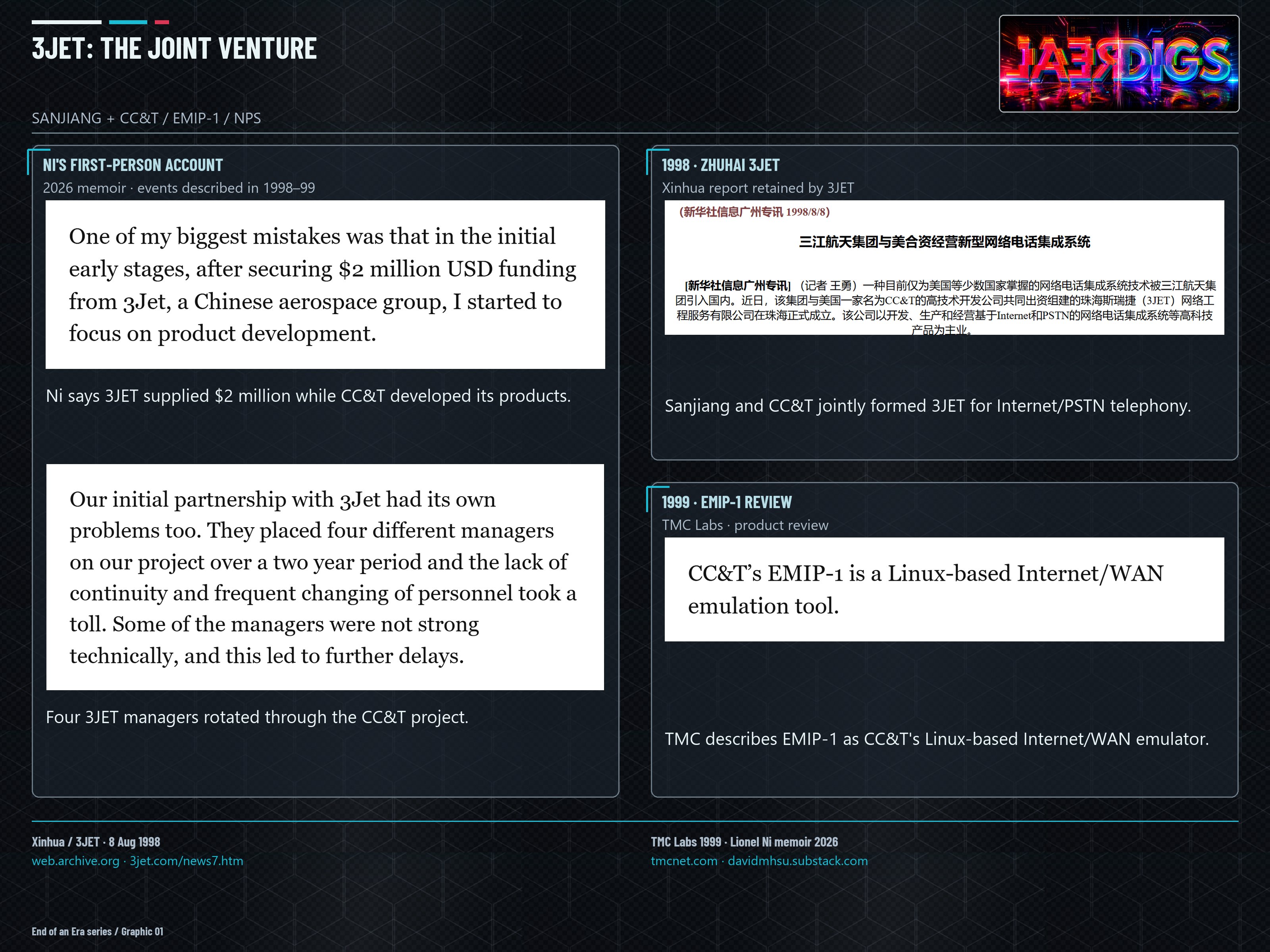
🇺🇸🇨🇳Sanjiang and Michigan-based CC&T formed 3JET in Zhuhai in 1998 to build Internet/PSTN telephone systems.
🇨🇳By October 1999, 3JET was manufacturing and selling internet-telephony products while CC&T offered NPS gateways and the $3,000 EMIP-1 emulator.
💵Lionel Ni says 3JET supplied $2 million and placed four managers on CC&T’s project. EMIP-1 was built to test its VoIP software.
Building units across that partnership required working equipment and production knowledge to move between the companies. 🖥️🚀
(2/5) The July 2001 overlap
🇨🇳Interstellar (Hangzhou) was the company behind eBanswers.
🇺🇸🇨🇳Its 2001 page said CC&T established it; company records list Ni and En-Wei Chai with 25% each and Chen Chengqiang with 50%.
🇺🇸🇭🇰LJ Connection’s Michigan record says July 2, 2001. A retained Guangzhou Xinhua record naming Jonathan Choi prints July 2 as its establishment date and July 3 in its introduction.
🖥️🛜On July 12, HKUST’s Yeung–Ding intrusion paper was received—the date CAIDA assigns to Code Red I’s first spread.
(3/5) The reseller and successor
🇺🇸🇨🇳On October 7, 2001, LJ Connection became a U.S. agent for eBanswers’ e-shop/eCRM products. LJ sold PBX/VoIP gateways. By October 2002, the same http://ljconn.com product URLs carried Konnech branding and nearly identical descriptions.
🇺🇸🇭🇰Konnech later said it began in 1999 and was called LJ Connection in 2001. Ni says HKUST approached him late that year; he joined in July 2002.
💰🤑If LJ resold the same gateway family, that strongly suggests shared 3JET/CC&T hardware configurations and a route for support data to reach the Hangzhou partner.
2source links
(4/5) Other American entry points
🇺🇸🇨🇳CC&T/3JET was not the only U.S.–China aerospace-linked commercial channel.
🚗In October 1997, GM-owned Delphi Automotive Systems China contracted with Shanghai Automotive Air Conditioning Factory to bring vehicle-system design and manufacturing technology into a joint venture.
🇨🇳💰It was formally established January 25, 1998: $24 million registered capital, 66% Chinese and 34% Delphi; the Chinese side contributed $15.84 million in assets and Delphi $8.16 million cash.
The factory sat within a Shanghai aerospace corporate chain.
🛜In March 2000, CathayOnline entered a 70/30 agreement with a Second Academy telecom station and its Beijing company to create an ISP, proposing roughly $2.5 million in equipment and operating capital.
Delphi’s venture was established and funded and Cathay’s filed agreement shows the intended equipment channel. The products differed but the access to aerospace institutions existed nonetheless.
(5/5) Networks, data and the export question
🚀StarBridge Global entered CCF StarBridge Hengxin on July 24, 2000. Its 45% stake joined a Chinese computer company’s 55% in network integration and applications; the venture reported a national ISP license.
🚀On November 13, StarBridge acquired an indirect 60% interest in Ai Wei, a smart-card registration and data-management business. China Changfeng held 40%.
A Chinese filing places the Hengxin-side company under Changfeng Group and Second Academy Institute 204.
By 2001, Ai Wei reported roughly 7,000 cards sold, and Hengxin reported $7.866 million in nine-month sales.
Separately, TurboLinux dates its Chinese-majority Beijing venture to July 2001. Later reporting identifies an aerospace-linked Chinese shareholder, while a period annual report identifies the related Huadi company as CASIC-controlled.
Put beside the Iran/Iraq/Syria export file, these ventures show how broad the aerospace sector’s commercial technical pool had become. What could its procurement and export channels draw from that pool?
Here's a map.
I use X Money! Help keep the lights on if you can; AI is getting wicked expensive to keep up this kind of content derived from 100K+ datapoints!
Check out the bottom of the home page at https://gusquixote.com for secure ways to help!