
Article REALDIGS / Original article
A Digital Bill of Rights
Every protection in the Bill of Rights answers an abuse its authors had lived through. The Fourth Amendment's demand for probable cause and a warrant "particularly describing the place to be searched, and the persons or things to be seized" answered the general warrant and the writ of assistance, which let officers search wherever they chose. The Fourteenth Amendment answered the Black Codes, which limited freed people's rights to own property and use the courts, and secured the Civil Rights Act of 1866 against legal challenge. In both cases a power over persons had outrun the law, and Americans wrote the missing terms into the Constitution rather than wait for courts to improvise them.
The networked economy has produced the next such power: a person's location, genome, face, voice, finances and correspondence now exist as records held by companies, traded by data brokers and requested by government agencies, usually without the person's knowledge. The Digital Bill of Rights proposes ten constitutional amendments that would settle who owns those records and on what terms anyone else may reach them.
From English Common Law to American Common Law
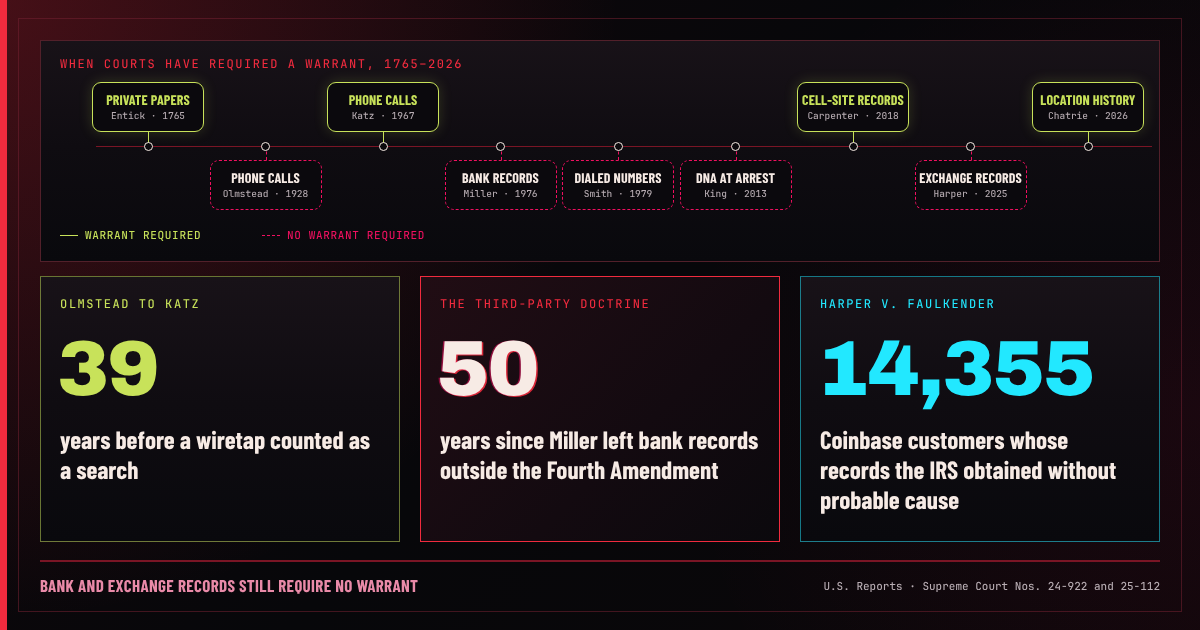
American search law began in England, where Lord Camden in Entick v. Carrington (1765) voided a general warrant to seize a writer's papers, "his dearest property," and the Supreme Court relied on that judgment in Boyd v. United States (1886) to hold that compelling a person to produce private papers violates the Fourth and Fifth Amendments.
The founding generation moved sovereignty from Parliament, which could rewrite the common law at will, to the people. Chief Justice John Jay called Americans "sovereigns without subjects" and "joint tenants in the sovereignty" in Chisholm v. Georgia (1793), and a written Constitution put their rights beyond any legislature's reach. The presumption of innocence, "axiomatic and elementary" in Coffin v. United States (1895), and proof beyond a reasonable doubt, a requirement of due process since In re Winship (1970), came from the common law and now bind every American court. Equal protection reaches "all persons within the territorial jurisdiction" regardless of nationality (Yick Wo v. Hopkins, 1886), which is why this proposal speaks of Persons rather than citizens, and the Tenth Amendment reserves to the States or the people every power not delegated to the federal government.
Personal sovereignty, due process, equal protection, the reserved powers of the States, probable cause, reasonable doubt and the presumption of innocence together distinguish American Common Law from its English parent, and the Digital Bill of Rights would carry that body of law into digital records.
The Fourth Amendment and New Technology
Each new medium has reopened what counts as a person's papers, and answers have come decades late. Olmstead v. United States (1928) held that tapping a bootlegging ring's telephones was no search because officers never entered the premises. Justice Louis Brandeis, who had co-written "The Right to Privacy" in 1890 in response to intrusive cameras and newspapers, dissented, warning that government might one day reproduce papers in court "without removing papers from secret drawers." Katz v. United States adopted his position thirty-nine years later, holding that "the Fourth Amendment protects people, not places."
United States v. Miller (1976) then left a depositor unable to challenge a subpoena for his own bank records, and Smith v. Maryland (1979) extended that reasoning to the numbers a person dials, creating the third-party doctrine under which information shared with a business loses constitutional protection.
The Court has since narrowed the doctrine one technology at a time, refusing to apply it to cell-site records in Carpenter v. United States (2018) or, on June 29, 2026, to Google Location History in Chatrie v. United States, though Chatrie left the geofence warrant's validity to a lower court. Financial records remain outside that line: a federal court ordered Coinbase to give the IRS records on 14,355 customers under a "John Doe" summons, for which "probable cause is not required." Thirteen years after Justice Sotomayor called the doctrine "ill suited to the digital age," the Supreme Court declined in June 2025 to hear one customer's challenge.
The Records at Stake
The records at stake now include the body itself. California's Supreme Court held in Moore v. Regents of the University of California (1990) that a patient had no conversion claim over his excised cells after his doctors used them in research. In 2013 the U.S. Supreme Court held that natural DNA segments cannot be patented merely because they have been isolated (Association for Molecular Pathology v. Myriad Genetics), and upheld, 5–4, DNA swabs of people arrested for serious offenses before any conviction (Maryland v. King). In 2025 a bankruptcy judge approved the $305 million sale of 23andMe, a genetic-testing company with more than 15 million customers, after more than two dozen states sued to halt it, and the judge wrote that selling genetic data "is a scary proposition."
Faces, voices and fingerprints are similarly exposed, and Illinois's 2008 Biometric Information Privacy Act remains a rare law letting a person sue over their collection.
Congress barred data brokers from selling Americans' sensitive data to foreign adversaries in 2024, and the Justice Department's Data Security Program, in force since April 8, 2025, restricts bulk transfers of Americans' genomic, biometric, location, health and financial data to China and other countries of concern.
The Ten Articles
The proposal rests on a doctrine it calls Equal Code Under Law, which treats a person's digitized records as extensions of the person, governed by existing property, intellectual-property and tort law.
I. State and Congress shall make no law abridging the Rights of any Person to the possession of any coded representation or digitization of that Person, and shall obtain no such representation or digitization from any party except by warrant or other judicial process.
II. State and Congress shall ensure digital access, education, and stewardship of digital services for all Persons.
III. Civil and criminal Digital Law shall be forever bound by jurisprudence in Common Law and preceding American applications thereof, and no warrant or other judicial process for any matter protected by this Digital Bill of Rights shall issue but upon probable cause, supported by Oath or affirmation, particularly describing what is to be searched or obtained, and with notice to the Person.
IV. State and Congress shall protect digitized representations of a Person and their physical existence equally as to any Rights previously afforded a Person under the Constitution of the United States of America.
V. State and Congress shall protect digitized records equally as to physical records, whoever holds them, and shall obtain no such record except by warrant or other judicial process.
VI. State and Congress shall make no law abridging the Rights of a Person over their Intellectual Property, incidental or accidental, generated as consequence of a Person's physical existence, and shall obtain no such Intellectual Property except by warrant or other judicial process.
VII. State and Congress shall levy no tax, fine, or tribute upon any Person's private digitized metaphysical extensions of a Person's physical existence, and shall compel no subjugation or use of them except by warrant or other judicial process.
VIII. As fundamental scientific truths hold that DNA is the fundamental essence of every living thing, State and Congress shall levy no tax, fine, or tribute upon any Person's DNA, and shall compel no subjugation or use of it except by warrant or other judicial process.
IX. State and Congress shall require that all machine-generated material be publicly and openly identified as such to anyone that may observe, interact with, or possess it.
X. In all matters of Personal sovereignty and Liberty, any Rights not explicitly protected by this Digital Bill of Rights are reserved to the Person.
The States and Article V
The proposal places the infrastructure with the States. Each would run an encrypted identity network federated through its counties and municipalities, and each person could keep records on their own device, license particular uses, including name, image and likeness, or hold everything offline. Every access, including by police and regulators, would be written to an encrypted ledger the person can read, extending to third-party records the receipt that federal rules already require officers to leave when they execute a warrant.
The States are already writing this law: California passed the first state law guaranteeing college athletes' name, image and likeness rights in 2019, and in July 2025 the Senate voted 99–1 to strip a ten-year moratorium on state AI laws from the budget bill. Five months later, Executive Order 14365 set up a Justice Department task force to challenge state AI laws in court. A constitutional floor would secure the person's rights while leaving each State free, in Justice Brandeis's phrase, to "serve as a laboratory."
Article V requires two-thirds of both houses of Congress, or a convention called by two-thirds of the state legislatures, to propose an amendment, and three-fourths of the States to ratify it. The telephone waited thirty-nine years for Katz, and the third-party doctrine turned fifty this year. The Digital Bill of Rights would settle the status of every record a person generates before the next technology arrives rather than decades after it.
Sources
- U.S. Constitution, Amendments IV and X, National Archives transcription
- U.S. House of Representatives, History, Art & Archives, "House Passage of the Fourteenth Amendment" (June 13, 1866)
- Boyd v. United States, 116 U.S. 616 (1886), quoting Entick v. Carrington, 19 Howell's State Trials 1029 (C.P. 1765)
- Chisholm v. Georgia, 2 U.S. 419 (1793) (Jay, C.J.)
- Coffin v. United States, 156 U.S. 432 (1895)
- In re Winship, 397 U.S. 358 (1970)
- Yick Wo v. Hopkins, 118 U.S. 356 (1886)
- Olmstead v. United States, 277 U.S. 438 (1928) (Brandeis, J., dissenting)
- Samuel D. Warren and Louis D. Brandeis, "The Right to Privacy," 4 Harvard Law Review 193 (1890)
- Katz v. United States, 389 U.S. 347 (1967)
- United States v. Miller, 425 U.S. 435 (1976)
- Smith v. Maryland, 442 U.S. 735 (1979)
- Carpenter v. United States, 585 U.S. 296 (2018)
- Chatrie v. United States, No. 25-112 (U.S. June 29, 2026), slip opinion
- Government's brief in opposition, Harper v. Faulkender, No. 24-922 (May 30, 2025)
- Docket, Harper v. Faulkender, No. 24-922 (certiorari denied June 30, 2025)
- United States v. Jones, 565 U.S. 400 (2012) (Sotomayor, J., concurring)
- Moore v. Regents of the University of California, 51 Cal. 3d 120 (1990)
- Association for Molecular Pathology v. Myriad Genetics, Inc., 569 U.S. 576 (2013)
- Maryland v. King, 569 U.S. 435 (2013)
- NPR, "Judge OKs sale of 23andMe — and its trove of DNA data — to a nonprofit led by its founder" (June 30, 2025)
- Biometric Information Privacy Act, 740 ILCS 14 (P.A. 95-994, 2008)
- Protecting Americans' Data from Foreign Adversaries Act of 2024, Pub. L. 118-50, div. I
- U.S. Department of Justice, "Preventing Access to U.S. Sensitive Personal Data and Government-Related Data by Countries of Concern or Covered Persons," 90 Fed. Reg. 1636 (Jan. 8, 2025)
- 28 C.F.R. § 202.601, countries of concern
- Federal Rule of Criminal Procedure 41(f)
- California SB 206 (2019), collegiate athletics: student athlete compensation and representation
- U.S. Senate Committee on Commerce, Science, and Transportation, "Senate Strikes AI Moratorium from Budget Reconciliation Bill in Overwhelming 99-1 Vote" (July 1, 2025)
- Executive Order 14365, "Ensuring a National Policy Framework for Artificial Intelligence," 90 Fed. Reg. 58499 (Dec. 16, 2025)
- New State Ice Co. v. Liebmann, 285 U.S. 262 (1932) (Brandeis, J., dissenting)
- U.S. Constitution, Article V