


Report Letters of Marque / Research report
End of an Era, Part III: The Game
In American football, jet motion starts before the snap: a receiver races laterally across the formation behind the quarterback. He may take the handoff. Or the motion may exist only to force the defense to reveal itself.
Russiagate was not an accident. It was a power play built to outlast the voters’ verdict. The playbook was not new.
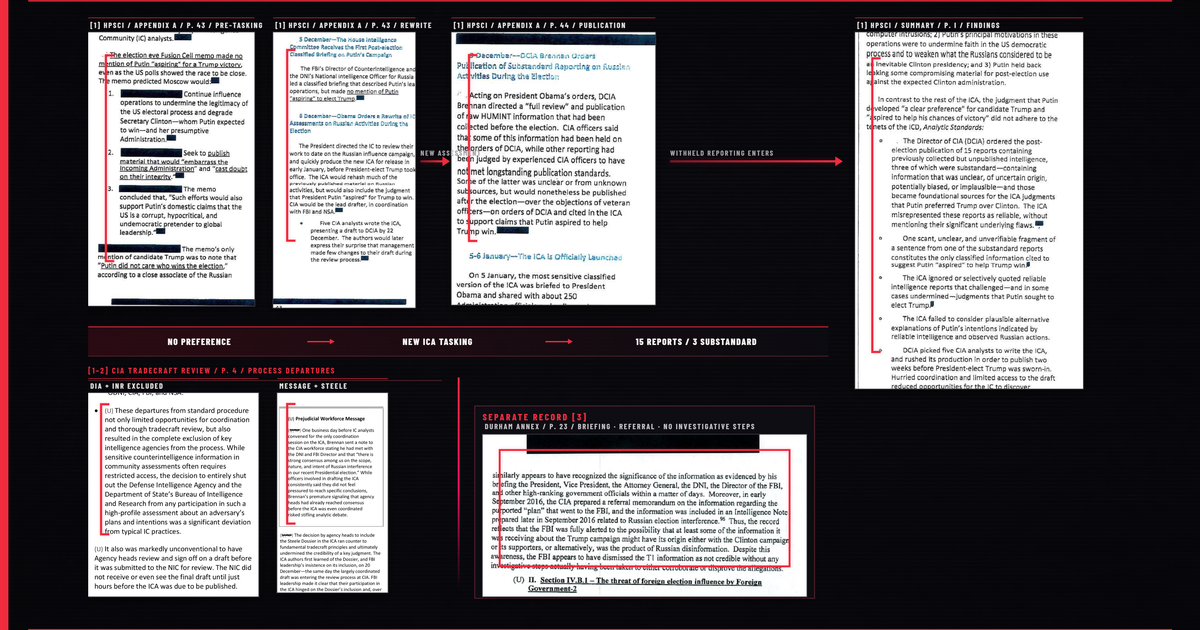
The September 2016 assessment described possible Russian disruption, made no Trump-preference judgment and recorded low confidence from the Federal Bureau of Investigation (FBI) and National Security Agency (NSA) in attributing the disclosures to Russia. A December 5 briefing still made no claim Putin sought Trump’s election. After the December 9 White House meeting, Director of National Intelligence James Clapper’s staff transmitted the presidential tasking for a new assessment. The declassified House Permanent Select Committee on Intelligence majority-staff review found Central Intelligence Agency (CIA) Director John Brennan ordered publication of fifteen previously withheld reports; three had failed ordinary publication standards and became foundational to the new judgment. That review found one “scant, unclear, and unverifiable fragment” behind “aspired” and reliable contrary intelligence omitted or selectively quoted. CIA’s own review confirms senior officers objected to inserting Steele material. 1

House Permanent Select Committee on Intelligence majority-staff review, PDF page 4 (printed p. i): its summary records fifteen previously unpublished CIA reports ordered into post-election publication, three judged substandard, together with contrary intelligence and a five-analyst drafting process. 1
NSA Director Admiral Michael Rogers warned that his analysts lacked access and time; Clapper called the deadline “not negotiable.” A former deputy national intelligence officer said he was denied the supposedly decisive reporting and pressured to concur. CIA’s 2025 review found that the “aspired” judgment was produced under excessive agency-head involvement, complete exclusion of the Defense Intelligence Agency (DIA) and the State Department’s Bureau of Intelligence and Research (INR), unequal source access, omitted alternatives and a confidence level the evidence did not merit. 2

The September record, December tasking, withheld reporting, excluded agencies, and coordination timeline in one view. 1 2
The declassified appendix to Special Counsel John Durham’s report shows that CIA briefed Obama, Biden, Clapper and FBI Director James Comey on intelligence alleging a Clinton-campaign plan to create a Trump–Russia scandal, then referred it to the FBI. Durham found no meaningful FBI attempt to test it while campaign-funded and campaign-linked allegations against Trump were pursued. 3
The 2020 files released in July 2026 are explicit. In an exchange over a pending President’s Daily Brief (PDB), an NSA analyst wrote: “We have deliberately massaged our one pending PDB to avoid any direct links to the election.” The National Intelligence Officer (NIO) for Cyber called it part of a broader Intelligence Community pattern of “deliberately avoiding mentioning a connection to elections for non-substantive reasons.” The reporting concerned China’s acquisition of American voter data; the exchange records officials stripping the election nexus from a pending presidential briefing. 4
The August 2026 Round River release showed an FBI Foreign Influence Task Force team gathering “any/all derogatory information” on Biden and Ukraine. Analysts added products to source files; a defensive-briefing matrix applied the label “conduit” to Cabinet officials, lawmakers and journalists. The FBI says 14 of 53 potentially compromised sources reported derogatory Biden information; tens of thousands of pages remain under review. 5

Separate referral handling and Round River’s gather, classify, and brief process. 3 5
The Office of the Director of National Intelligence (ODNI) says its Election Threats Executive coordinated with Twitter, Facebook and Google on their responses to the Hunter Biden laptop story shortly before Twitter restricted it. A contemporaneous NSA memo records a foreign-election report blocked after sixteen months’ delay and a proposal for a different product that would summarize and amalgamate the unreported data because release might damage NSA’s standing with the administration. 6

Office of the Director of National Intelligence DELTA Project slide deck, PDF page 2: the background slide describes the FBI Foreign Influence Task Force-Russia's Round River team and its collection of Biden- and Ukraine-related reporting through the 2020 election. 5

National Security Agency memorandum dated March 13, 2020, PDF pages 1-2: the writer records a foreign-election report delayed for sixteen months, debate over contextual identification, concern about release timing and NSA credibility, and a proposal for a different summarized product. 6

A sixteen-month reporting delay ended with a proposal for a different product. 6
The funnel
The Department of Energy (DOE) counterintelligence apparatus—the predecessor to today’s Office of Intelligence and Counterintelligence, one of the Community’s eighteen elements—produced the inquiry Part II left at the courthouse. The Department of Justice’s Bellows Report on its origins named the mechanism. 7
DOE’s inquiry “should have been a sieve.” Instead, it “ended up as a funnel.” 7
The Kindred Spirit Analytical Group produced a concise, limited scientific assessment of what China may have obtained from American nuclear-weapons programs. The FBI never saw it. What the Bureau received instead was a DOE inquiry whose edits converted a broad suspect list into a “virtual indictment” of Wen Ho and Sylvia Lee. 7
The FBI embraced the product, never tested its assumptions and ignored surviving leads. 7 The then-General Accounting Office (GAO) later found Assistant Director Neil Gallagher’s sworn confidence in the DOE inquiry “inaccurate and misleading”: the contrary field-office warning had been in his briefing book. 8
Meanwhile, DOE auditors had repeatedly found weak separation of classified and unclassified networks. A 1995 inspector-general review documented stale contractor accounts, shared user IDs, poor media inventories and inadequate activity monitoring at a headquarters facility where contractors were about 45 percent of 3,600 users. Classified information appeared on an unclassified network at Los Alamos National Laboratory (LANL) in 1998. 9
What the funnel closed
Bellows showed what vanished. DOE’s original plan was to identify People’s Republic of China (PRC) visitors and assignees at Los Alamos and Lawrence Livermore national laboratories and other facilities, then map their relationships with laboratory personnel. Other venues—and other people with access and China travel—fell away as the inquiry became the “virtual indictment.” 7

A broad Department of Energy inquiry narrowed into a virtual indictment before the Federal Bureau of Investigation saw it. 7
Lee told the FBI that meeting Institute of Applied Physics and Computational Mathematics (IAPCM) mathematician Li De Yuan at a mid-1980s Hilton Head conference led to invitations for China trips in 1986 and 1988; the Senate record says LANL and DOE approved both in advance. A defense memorandum in that record, citing the FBI case agent’s grand-jury testimony, identifies Sylvia Lee as an FBI “Information Asset” from 1985 to 1991 and says Wen attended at least two meetings with her FBI contact. A 1987 IAPCM note requested three LANL reports. Lee’s 1988 foreign-trip report omitted Hu Side, identified in the FBI affidavit as head of China’s nuclear-weapons program by 1994. The 1997 draft Foreign Intelligence Surveillance Act (FISA) application said Wen had offered help but was not used. Contemporaneous FBI files said his assistance produced results “far better than had been anticipated.” 10
After reviewing FBI, CIA and DOE records, Judge James Parker found exculpatory material involving the Lees’ cooperation, reliability and motives. The congressional review said a trial “certainly had the potential to embarrass the government.” The plea followed Parker’s ruling that Lee had to be released pending trial. 10

The record described a Federal Bureau of Investigation asset, a conflicting account of assistance and exculpatory material with potential to embarrass the government. 10
The Committee of 100 (C100) was not a spectator. Its co-founder Henry Tang later said Lee “came to us through” defense lawyer Brian Sun and that C100 had “many people affiliated” with Los Alamos. After its legal team questioned Lee’s lawyers, it deemed the case “worthy of backing.” C100’s history records contacting President Bill Clinton over the case in 1999, bringing Energy Secretary Bill Richardson before its annual conference and leading sixteen Asian-American organizations in a due-process campaign for Lee in 2000. Sun joined C100 after the case. 11
The bridge to the Council on American-Islamic Relations (CAIR) predates 9/11. In March 2000, The Minaret credited Lee’s daughter Alberta as a contributor to an article using her father’s case to warn Muslims about FBI interviews, cited a CAIR alert, and directed readers to obtain counsel through—and report FBI contacts to—CAIR. In 2004, Alberta attended CAIR-Sacramento’s banquet and compared James Yee’s collapsed prosecution to her father’s; in 2018, C100 and CAIR signed the same letter to FBI Director Christopher Wray. 11

Two records, shown separately: Henry Tang's account of Wen Ho Lee reaching the Committee of 100 through Brian Sun and the March 2000 Minaret article crediting Alberta Lee, citing a CAIR alert and directing readers to report FBI approaches to CAIR. 11

Committee of 100 involvement in the Lee case and March 2000 Council on American-Islamic Relations guidance appear in the same documentary sequence. 11
That narrowing unfolded inside an intelligence and technology conflict with China. Three days before the May 1999 strike on China’s Belgrade embassy, a CIA officer challenged the target’s location; the concern did not trigger a halt or revalidation. The bombs killed three. Beijing suspended high-level military exchanges and postponed arms-control and international-security talks; Chinese hackers defaced U.S. government sites. On August 19, CIA and FBI sent Congress a classified report; its public version described Chinese collection through students, scientists, research institutes, companies and technical exchanges—including U.S. national laboratories. 12 13
The Michigan State University (MSU) cluster maps the access layer. Lionel Ni and his doctoral student Vibhavasu Vuppala developed scalable-router and virtual-network-port prototypes. Ni, Matt W. Mutka and Abdol-Hossein Esfahanian shared the National Science Foundation (NSF) Emulate the Performance of Wide Area Networks (EMPOWER) grant; Ni and Pei Zheng’s EMPOWER paper described an emulator that imposed bandwidth, delay, loss and topology on live packet traffic. Ni co-founded Michigan-based Computer Communication & Telecommunication Technologies, Inc. (CC&T), which by August 1999 sold EMIP-1, a Linux wide-area-network emulator displaying packet statistics. 14 15 16

Router research, virtual ports, and a commercial wide-area-network emulator appeared in a 1997–99 cluster. 14 15

A March 2000 National Science Foundation award names Mutka, Ni, and Esfahanian; a separate 2012 paper names Vuppala and Department of Energy support. 16
A 1998 Huaqiao Bao report reproduced on 3JET’s own site says China Sanjiang Aerospace Group and CC&T jointly funded Zhuhai Siruijie Network Engineering Service and identifies Sanjiang’s deputy general manager as Siruijie’s chairman; an archived 1999 company page presents 3JET as Siruijie’s brand. Sanjiang belonged to China’s state aerospace system later reorganized under what became the China Aerospace Science and Industry Corporation (CASIC); the State-owned Assets Supervision and Administration Commission of the State Council (SASAC) lists CASIC as a central state-owned enterprise whose approved core business includes military production. 17

Documented 1998 structure: A 1998 report reproduced on 3JET’s site says CC&T and China Sanjiang jointly funded Zhuhai Siruijie Network Engineering Service. 15 17

Archived source records: A 1998 report reproduced on 3JET’s site says CC&T and China Sanjiang jointly funded Zhuhai Siruijie Network Engineering Service. 15 17
Vuppala later coauthored the DOE-supported Facility for Rare Isotope Beams (FRIB) software architecture. Xipeng Xiao, another Ni student, coauthored the account of GlobalCenter’s Multiprotocol Label Switching (MPLS) network before working at Huawei Europe. 16 18

Official National Science Foundation, curriculum-vitae and FRIB records showing the EMPOWER investigators, Vibhavasu Vuppala's doctoral-student listing and a separate U.S. Department of Energy-supported FRIB software paper. 15 16 18
The untested access question extended beyond file custody: who could reach the people, vendors, code and routing devices through which laboratory traffic moved? Presidential Decision Directive 63 (PDD-63) treated telecommunications and energy as interdependent infrastructure, drew universities and industry into the federal protection system and placed the FBI’s National Infrastructure Protection Center at the public-private junction. By January 2001, InfraGard covered all 56 FBI field offices. 19 20

Presidential Decision Directive 63 placed the FBI’s National Infrastructure Protection Center between federal systems and private infrastructure; InfraGard carried the channel to every field office. 19 20
The funnel reduced a system-level inquiry to one scientist. The case ended in one plea before the discarded access paths—or the government’s own place inside them—were tested in public.
The clues that did not travel
In January 2000, CIA knew suspected al-Qaeda operative Khalid al-Mihdhar held a multiple-entry U.S. visa; by March it knew Nawaf al-Hazmi had flown to Los Angeles. An FBI detailee drafted a report to FBI headquarters and New York. A CIA officer marked it “hold off” on orders from the Bin Laden Unit’s deputy chief. It remained a draft. The visa and travel facts reached FBI operational channels only in late August. Watchlisting came August 24; the search opened August 29. 21
Part I traced the CIA’s investment bridge into commercial technology. By 2001, Greater Phoenix already concentrated the technologies such a bridge sought: semiconductors, military electronics and Boeing’s Mesa complex, where military rotorcraft were designed, assembled, tested and produced. Mesa Phantom Works personnel also worked on Defense Advanced Research Projects Agency (DARPA) and Air Force unmanned-aircraft programs, including reconnaissance and communications/data-relay concepts. 22
The warning that emerged from Phoenix came through aviation’s civilian edge. On July 10, 2001, a Phoenix agent reported an “inordinate number” of persons of interest in aviation training and proposed a nationwide aviation-school inventory, local FBI–school liaison and visa tracking. It was not broadly distributed. After a Minnesota school flagged Zacarias Moussaoui on August 15, a headquarters analyst printed the Phoenix memo but never gave it to Minneapolis agents or the lawyers reviewing their request. Three of those four lawyers later said it would have changed their response. Headquarters declined to send the FISA request to Justice Department intelligence lawyers. Moussaoui’s belongings were searched after the attacks. 23
The record was not empty. It was compartmented: CIA had visa and travel; Phoenix had an aviation warning; Minneapolis had Moussaoui in custody. The government did not assemble the picture in time.
The crisis did not create the interfaces; it enlarged them. The Communications Assistance for Law Enforcement Act (CALEA) had already required carriers to build authorized interception into commercial networks. InfraGard opened direct, secure channels between infrastructure owners and local FBI offices. 20 After 9/11, Joint Terrorism Task Forces (JTTFs) grew from 35 to 103; 55 percent of their 5,085 members came from outside the FBI, including law-enforcement, intelligence and military agencies. 24
Section 314 of the Uniting and Strengthening America by Providing Appropriate Tools Required to Intercept and Obstruct Terrorism (USA PATRIOT) Act turned the financial system into another search layer. By 2005, a single Financial Crimes Enforcement Network (FinCEN) request could reach roughly 20,000 institutions. By 2018, automated FBI searches of Bank Secrecy Act filings generated about 2,000 alerts a month; those filings were directly linked to the principal subject in roughly one-quarter of pending FBI investigations. 25
Contractors supplied the people, machines and oversight. At Leon Panetta’s 2009 confirmation hearing, Dianne Feinstein said intelligence contractors had doubled from 2001 to 2006, most hired after 9/11, at an estimated $80,000 annual premium over government employees. Sentinel made the structure literal: Lockheed Martin received $305 million to build the FBI’s case system; contractors filled 74 percent of its planned program office; Booz Allen Hamilton received the separate Phase 1 verification-and-validation role. 26
In 2005, the FBI formed a university board to build terrorism and counterintelligence channels and develop national-security research, curricula, internships, recruiting and faculty consulting. University of California San Diego was a founding member. 27

Justice Department inspector-general and Government Accountability Office excerpts documenting post-September 11 Joint Terrorism Task Force expansion and the later FBI Bank Secrecy Act Alert System figures. 24 25
Edward Snowden made the contractor architecture visible: an NSA contractor possessed access sufficient to remove a vast archive from secure government networks. The circumstances of his access, disclosure sequence and Hong Kong-to-Russia transit remain a circumstantial record that may not be resolved without further declassification. 28
The memos that kept the switch on
The joint inspectors-general report on the President’s Surveillance Program records the clearest massaged product. President George W. Bush signed the first authorization October 4, 2001, permitting specified NSA surveillance inside the United States without Foreign Intelligence Surveillance Court orders. Between then and December 8, 2006, he signed 43 authorizations in all, generally at intervals of about 45 days. The relevant activities moved under FISA authority in January 2007. 29
Analysts drafted the threat assessments without knowing the program—or how their work would be used. The Director of Central Intelligence’s chief of staff appended language traced to a senior White House official: a continuing domestic threat, followed by a recommendation to renew. CIA lawyers requested revisions when drafts lacked sufficient threat information or failed to make a “compelling case.” 29
No law required the Attorney General to certify the authorizations. Alberto Gonzales said the signature reassured NSA and cooperating private-sector personnel and, for “purely political considerations,” would have “prospective” value in a future congressional or inspector-general review. 29
Compartmented leads reached FBI offices with insufficient detail and no adequate prioritization. Most were determined to have no connection to terrorism. The Bureau nevertheless required every lead to be followed because one genuine lead could matter; the inspectors general concluded that the program generally played only a limited role in FBI counterterrorism. 29
When Justice Department lawyers later concluded that parts of the program lacked a viable legal basis, Robert Mueller and James Comey were prepared to resign. The program was modified. 29 The Bureau had executed the funnel and, at a critical point, resisted it.
Threat became assessment. Assessment became authorization. Authorization activated public and private infrastructure. Collection created volume; volume required systems; systems required contractors. Each layer became the reason for the next.
A recycled playbook
The CIA supported the Warren Commission while withholding its own plots to kill Fidel Castro. The House Select Committee on Assassinations later exposed the circular defense: the Commission had not asked about operations it had never been told existed. 30
In August 1964, nine months after President John F. Kennedy’s assassination and while the Warren Commission was still working, intelligence helped carry the United States into a much larger war. NSA historian Robert Hanyok concluded that the August 4 attack never happened. His reconstruction found six signals-intelligence products admitted to the chronology and roughly 90 percent of the available signals intelligence kept out; contrary intercepts were excluded, fragments lifted from context, and the administration’s principal proof assembled by joining two unrelated messages. 31
Different decades, same conversion. The Warren Commission lacked information held by the agencies assisting it. Tonkin policy used signals intelligence to justify a decision while the record remained conflicted. DOE’s limited assessment never reached the FBI. Pre-9/11 clues stopped at agency and unit boundaries. President’s Surveillance Program threat assessments were edited to support renewal. The post-election 2016–17 assessment converted selected, substandard reporting into a predetermined political conclusion.
Part IV turns to the military response after September 11, and to the intelligence products, civilian channels and named players that made particular operations appear necessary, lawful and inevitable.
Footnotes
-
1. Office of the Director of National Intelligence, declassified pre- and post-election intelligence record, July 17, 2025; House Permanent Select Committee on Intelligence majority staff, declassified oversight investigation and referral, approved for release July 22, 2025; CIA Directorate of Analysis, Tradecraft Review of the 2016 Intelligence Community Assessment, June 26, 2025, pp. 4–5; Paul Sperry, “How Obama Admin Turned ‘Unverifiable’ Report Into Russiagate Dynamite”, RealClearInvestigations, July 24, 2025.
https://www.cia.gov/static/Tradecraft-Review-2016-ICA-on-Election-Interference-062625.pdf
-
2. Office of the Director of National Intelligence, declassified Rogers–Clapper email, released August 13, 2025; ODNI, declassified intelligence-officer testimony, released July 30, 2025, p. 12; CIA Directorate of Analysis, Tradecraft Review of the 2016 Intelligence Community Assessment, June 26, 2025, pp. 3–6.
https://www.cia.gov/static/Tradecraft-Review-2016-ICA-on-Election-Interference-062625.pdf
-
3. Special Counsel John Durham, declassified appendix, released July 31, 2025.
-
4. White House, China’s Acquisition and Exploitation of American Voter Data document archive, released July 16, 2026,
EMAIL_NSA.MassagedPDB_20NOV2020_DECLASS_REDACT.pdf, pp. 2, 5; White House Government Transparency Task Force, interagency-approved fact sheet, July 30, 2026. -
5. Office of the Director of National Intelligence, DELTA Project slide deck, p. 2, and defensive-briefing matrix, pp. 1–3, contained in the White House Round River document archive, released August 12, 2026; Federal Bureau of Investigation, statement on Round River, p. 1; John Solomon and Steven Richards, “FBI had 14 informants on Biden corruption but ran secret op to dismiss evidence as disinformation”, Just the News, August 12, 2026; House Judiciary Committee, September 2 follow-up letter.
https://www.whitehouse.gov/wp-content/uploads/2026/08/Round-River.zip
https://justthenews.com/sites/default/files/2026-08/Round%20River%20Statement%20from%20FBI.pdf
-
6. National Security Agency official, contemporaneous memorandum concerning delayed election-threat reporting, March 13, 2020, declassified August 12, 2026; Office of the Director of National Intelligence, ODNI 2.0 Fact Sheet and release record, August 20, 2025; Department of Justice Office of Inspector General, The Federal Bureau of Investigation’s Efforts to Coordinate and Address Foreign Influence Operations and Misinformation and Disinformation Threats Directed at U.S. Elections, July 2024; Natalie Winters, “FBI Agent Responsible for Facebook Censoring Hunter Biden’s Hard Drive...”, War Room, July 2, 2023.
https://www.whitehouse.gov/wp-content/uploads/2026/08/Untitled.pdf
https://www.odni.gov/files/ODNI/documents/ODNI-20-Fact-Sheet.pdf
https://www.odni.gov/3547/pr-24-25/
https://oig.justice.gov/sites/default/files/reports/24-080.pdf
-
7. Office of the Director of National Intelligence, Department of Energy Office of Intelligence and Counterintelligence; Department of Justice Office of Inspector General, The Federal Bureau of Investigation’s Efforts to Coordinate and Address Foreign Influence Operations and Misinformation and Disinformation Threats Directed at U.S. Elections, p. 6 n.1; Department of Justice, Bellows Report, Chapter Seven, May 2000, pp. 339–348.
https://oig.justice.gov/sites/default/files/reports/24-080.pdf
https://www.justice.gov/sites/default/files/ag/legacy/2001/12/11/bellows7.pdf
-
8. U.S. General Accounting Office, Review of FBI Congressional Testimony, GAO-01-869R, June 28, 2001, pp. 2–3.
-
9. Department of Energy Office of Inspector General, Review of the U.S. Department of Energy’s Information Management Systems, July 31, 1995, pp. 7, 11–14; U.S. General Accounting Office, Nuclear Security: Weaknesses in DOE’s Security Program, May 1999, pp. 13–14.
-
10. Senate Judiciary Subcommittee oversight record, Reports on the Cases of Dr. Wen Ho Lee and Dr. Peter Lee, Congressional Record, December 20, 2001, pp. S13795–S13796, S13799, S13815–S13817; FBI Special Agent Michael Lowe, search-warrant affidavit, April 9, 1999, paragraphs 13–20.
https://www.govinfo.gov/content/pkg/CREC-2001-12-20/pdf/CREC-2001-12-20.pdf
-
11. Committee of 100, economic-espionage seminar transcript, September 16, 2015, pp. 12–13, 20, and institutional highlights, p. 1; Maha El-Genaidi, “FBI and Muslims”, The Minaret, March 2000, pp. 19–21; Associated Press, “Muslim ex-spy suspect wins award, ovation”, November 22, 2004; Committee of 100 and others, letter to FBI Director Christopher Wray, March 1, 2018.
https://www.committee100.org/wp-content/uploads/2013/07/C-100-Highlights-English-13AUG2013.pdf
https://www.investigativeproject.org/documents/misc/890.pdf
https://www.seattlepi.com/news/article/muslim-ex-spy-suspect-wins-award-ovation-1160274.php
-
12. Director of Central Intelligence and Director of the FBI, Report to Congress on Chinese Espionage Activities Against the United States, classified version transmitted August 19, 1999; unclassified version transmitted December 12, 1999.
-
13. George Tenet, statement to the House Intelligence Committee on the bombing of the Chinese embassy in Belgrade, July 22, 1999; Ministry of Foreign Affairs of the People’s Republic of China, record of the bombing and suspended bilateral contacts; U.S.–China Economic and Security Review Commission, Capability of the People’s Republic of China to Conduct Cyber Warfare and Computer Network Exploitation, October 2009, pp. 37, 68.
https://irp.fas.org/congress/1999_hr/990722-tenet.htm
https://www.mfa.gov.cn/eng/zy/wjls/3604_665547/202405/t20240531_11367575.html
-
14. Vibhavasu Vuppala and Lionel Ni, “Design of a Scalable IP Router”, August 1997; Vuppala and Ni, “Layer-3 Switching Using Virtual Network Ports”, October 1999; Vuppala, Virtual Network Ports, Michigan State University dissertation, 2002.
https://www.researchgate.net/publication/238779326_Design_of_A_Scalable_IP_Router
https://researchportal.hkust.edu.hk/en/publications/layer-3-switching-using-virtual-network-ports-2/
-
15. Lionel Ni, curriculum vitae; Department of Energy Advanced Scientific Computing Research Advisory Committee, A History of the Office of Advanced Scientific Computing Research, pp. 6, 41, 47; TMC Labs, EMIP-1 product review, August 1999; EDN, CC&T Technologies profile, October 1, 1999.
https://science.osti.gov/-/media/ascr/ascac/pdf/reports/2020/ASCR40112020.pdf
-
16. National Science Foundation, Award 9911074, EMPOWER, March 2000; Pei Zheng and Lionel Ni, “EMPOWER: A Network Emulator for Wireline and Wireless Networks”, 2003; Vibhavasu Vuppala and others, “FRIB High-Level Software Architecture”, 2012; Department of Energy, Facility for Rare Isotope Beams.
https://api.nsf.gov/services/v1/awards/9911074.json
https://infocom2003.ieee-infocom.org/papers/47_03.PDF
-
17. 3JET, archived reproduction of Huaqiao Bao report, October 31, 1998, and archived Chinese company page; EDN, “New VoIP Player: CC&T Technologies”, October 1, 1999; State-owned Assets Supervision and Administration Commission of the State Council, Sanjiang relationship, central-enterprise list and CASIC core business. The joint-funding record names Sanjiang, not CASIC; the successor corporation adopted the CASIC name in 2001. Zhejiang Provincial Department of Commerce, official corporate history.
https://web.archive.org/web/19990829101208/http://www.3jet.com/news14.htm
https://web.archive.org/web/19991014000147/http://www.3jet.com/3jetcn.htm
https://www.edn.com/new-voip-player-cct-technologies/
https://wap.sasac.gov.cn/n2588025/n2588124/c26949921/content.html
https://wap.sasac.gov.cn/n2588045/n27271785/n27271792/c14159097/content.html
https://wap.sasac.gov.cn/n2588035/n2641579/n2641665/c3754103/content.html
https://zjic.zj.gov.cn/ywdh/cyfz/202604/t20260424_24050557.shtml
-
18. Lionel Ni, former doctoral students; Xipeng Xiao and others, “Traffic Engineering with MPLS in the Internet”, IEEE Network, March–April 2000; Internet Engineering Task Force, XiPeng Xiao profile.
https://cse.hkust.edu.hk/~ni/formerphd.html
https://dl.icdst.org/pdfs/files/c59ed6bcf436888348edfe445b713f30.pdf
-
19. The White House, Presidential Decision Directive 63, May 22, 1998.
https://clintonwhitehouse4.archives.gov/WH/EOP/NSC/html/documents/NSCDoc3.html
-
20. Federal Bureau of Investigation, introduction of the national InfraGard program, January 6, 2001.
-
21. Department of Justice Office of Inspector General, 9/11 review, Chapter Five, public release June 2006.
https://oig.justice.gov/sites/default/files/archive/special/s0606/chapter5.htm
-
22. Director of Central Intelligence, Annual Report for the United States Intelligence Community, 1999, In-Q-Tel section; Ralph Mahoney, “Industrial Boom,” Arizona Days and Ways / The Arizona Republic, March 10, 1957; Boeing, “Boeing Completes McDonnell Douglas Merger”, July 31, 1997; “Boeing Earns Quality Certification for Mesa Plant”, September 30, 1997; “Boeing/DARPA to Demonstrate Revolutionary Canard Rotor/Wing Concept”, June 3, 1998; “Phase II UCAV Contract Awarded To Boeing”, April 12, 1999.
https://irp.fas.org/cia/product/report-99.html
https://azmemory.azlibrary.gov/assets/displaypdf/332948
https://boeing.mediaroom.com/1997-07-31-Boeing-Completes-McDonnell-Douglas-Merger
https://boeing.mediaroom.com/1997-09-30-Boeing-Earns-Quality-Certification-for-Mesa-Plant
https://boeing.mediaroom.com/1999-04-12-Phase-II-UCAV-Contract-Awarded-To-Boeing
-
23. Department of Justice Office of Inspector General, Chapter Three: Phoenix Electronic Communication and Chapter Four: Zacarias Moussaoui, public release June 2006.
https://oig.justice.gov/sites/default/files/archive/special/s0606/chapter3.htm
https://oig.justice.gov/sites/default/files/archive/special/s0606/chapter4.htm
-
24. Congress, Communications Assistance for Law Enforcement Act; Department of Justice Office of Inspector General, The Department of Justice’s Terrorism Task Forces, June 2005.
https://www.govinfo.gov/app/details/COMPS-937
https://oig.justice.gov/archives/reports/plus/e0507/results.htm
-
25. U.S. Government Accountability Office, USA PATRIOT Act: Additional Guidance Could Improve Implementation of Regulations Related to Customer Identification and Information Sharing Procedures, GAO-05-412, May 2005, p. 60; U.S. Government Accountability Office, Bank Secrecy Act: Agencies and Financial Institutions Share Information but Metrics and Feedback Not Regularly Provided, GAO-19-582, August 2019, p. 51.
-
26. Senate Select Committee on Intelligence, nomination hearing of Leon Panetta, February 5, 2009, p. 13; Department of Justice Office of Inspector General, Sentinel Audit II: Status of the Federal Bureau of Investigation’s Case Management System, Audit Report 07-03, December 2006, pp. ii, 24, 46.
https://www.intelligence.senate.gov/sites/default/files/hearings/111172.pdf
https://oig.justice.gov/archives/reports/FBI/a0703/final.pdf
-
27. Federal Bureau of Investigation, National Security Higher Education Advisory Board announcement, September 15, 2005.
-
28. House Permanent Select Committee on Intelligence, Review of the Unauthorized Disclosures of Former National Security Agency Contractor Edward Snowden, declassified September 2016; Department of Justice, statement on the request to Hong Kong for Snowden’s provisional arrest, June 26, 2013.
https://intelligence.house.gov/uploadedfiles/hpsci_snowden_review_declassified.pdf
-
29. Inspectors General of the Department of Justice, Department of Defense, CIA, NSA and ODNI, Unclassified Report on the President’s Surveillance Program, July 10, 2009, pp. 1–11, 19–36; Department of Justice Office of Inspector General, further-declassified Volume I, p. 7, and Volume III, released January 11, 2016.
https://www.oversight.gov/sites/default/files/documents/reports/2018-04/s0907.pdf
https://oig.justice.gov/sites/default/files/2020-07/PSP-01-08-16-vol-1.pdf
https://oig.justice.gov/sites/default/files/2020-07/PSP-01-08-16-vol-3.pdf
-
30. National Archives, House Select Committee on Assassinations findings concerning the performance of federal agencies, 1979.
https://www.archives.gov/research/jfk/select-committee-report/part-1d.html
-
31. National Security Agency, Robert Hanyok, Skunks, Bogies, Silent Hounds, and the Flying Fish: The Gulf of Tonkin Mystery, 2-4 August 1964, written 2000–2001 and released 2005, pp. 1–3, 43–44.